
Raptor
Precise, fast, discreet weapon adjustment.
The technological breakthrough in weapon adjustment
RAPACE (weapon adjustment by learning and calibrated correction) is an adjustment device offered by STARNAV.
The principle is a complete break with the state of the art. The problem has been approached with a fresh, unprejudiced eye, driven by a highly innovative approach. As a result, the following points are clear advantages over existing solutions:
- No object introduced at the end of the barrel
- Image processing to take account of the entire barrel length
- Presentation of a virtual crosshair at infinity in the shooter's viewfinder
- Eyecup-guide system, red dot or precision bezel can be set indifferently
- Optional real-world correction of reticle position to account for potential weapon faults, ammunition type, distance, weather and shooter. These parameters must have been set beforehand.
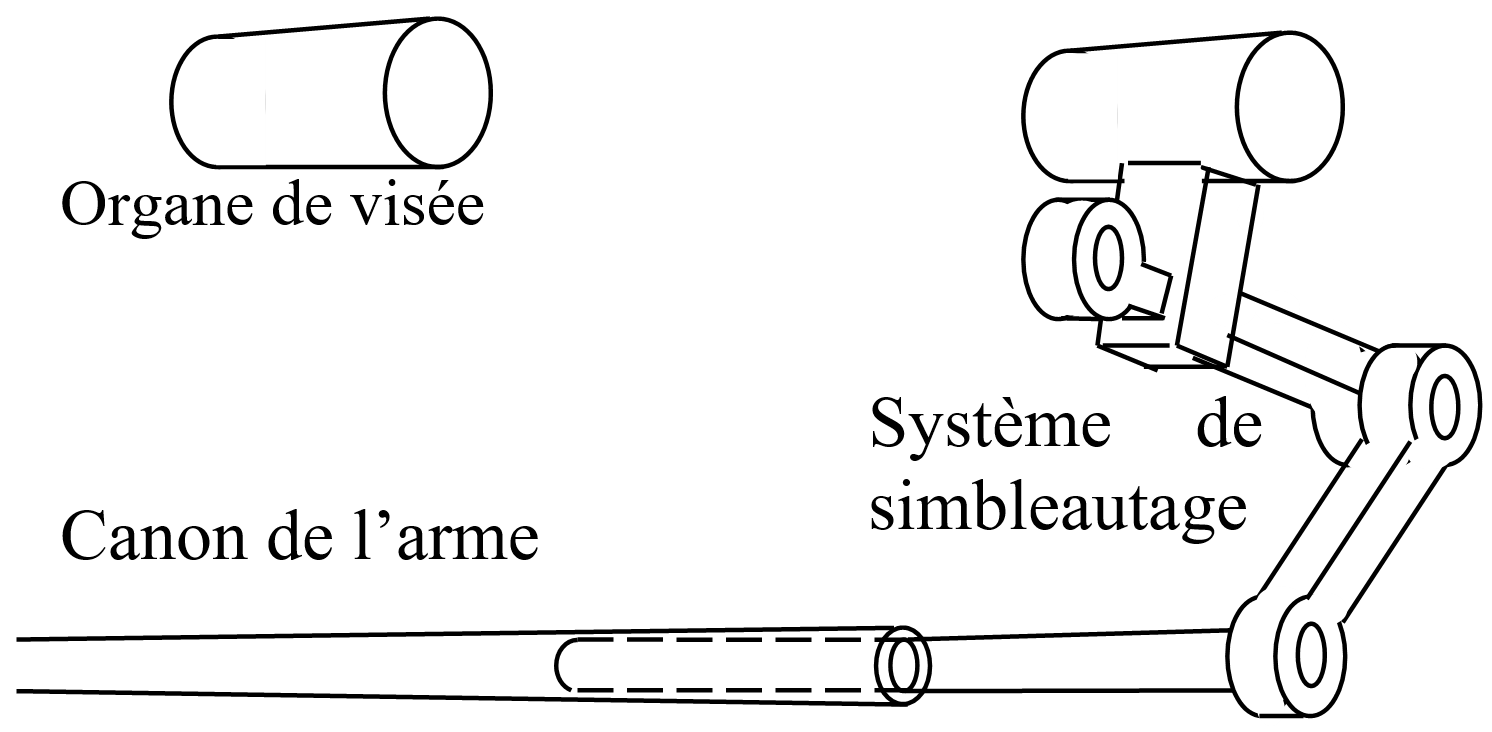
The system is positioned at the end of the barrel using a rigid rod adapted to the gun model. There are no fixing constraints in terms of barrel geometry. The only requirement is the stability of the connection. The image processing algorithms autonomously define the direction of the barrel axis in the camera frame of reference, then in the RAPACE optical system frame of reference (through which the user aims at the reticle).
The device will then supply a stable base of geometry relative to the barrel. The user can then select a basic setting for each type of weapon, or an individual fine-tuning setting taking into account one or more parameters.
Screen resolution is 0.5cm at 100m.
The complete accuracy of the measured setting is 1 cm at 100m.
Key features
Precision
RAPACE enables a weapon to be adjusted to an accuracy of 0.1 mrad, which corresponds to an error of 1 cm at 100m.
Speed
The time required to measure and adjust the weapon is less than 1 minute.
Discretion
No firing or emission is required. Set-up can be carried out at any time, even in a vehicle.
Benefits
Precision
RAPACE allows you to retrieve a previously stored setting with an accuracy of 1 cm at 100m. Every weapon is characterized by its own bias, to which is added the shooter's setting. À To these two main parameters can be added the notions of ammunition, sound reducer, thermal or altimetric environment. RAPACE lets you save as many settings as you need to find your weapon in a known configuration (or check that the setting has not been modified).
Speed
The gun is analyzed in a matter of seconds. RAPACE then displays a virtual crosshair in front of the sight, showing the line of fire at the previously recorded distance. The aiming device can be adjusted to this fixed point in a matter of seconds. The weapon is now in "firing point exit / weapon set" configuration.
Discretion
Setting a weapon without firing, without remote sights, without lasers, while retaining long-range setting capability, is a concrete contribution of RAPACE technology.
Customize settings
RAPACE brings the ability to share a long gun between several shooters while individualizing the setting. This innovation makes it possible to optimize weapon fleets while increasing engagement distances.
Ammunition savings
RAPACE saves ammunition. By avoiding dummy calibration shots.
Logistics gains
Thanks to RAPACE, firing slots can be freed up for operational training rather than maintenance firing.
In addition, the costs maintenance logistics can be drastically reduced. reduced thanks to the tool's new ability to find a setting without resorting to shooting in NTI3.
| Features | Detail |
|---|---|
| Category | Weapon adjustment system |
| Model | RAPACE 70 |
| Dimensions | Case 160 x 170 x 90 mm |
| Mass | 1150g |
| Compatible weapons | HK G36, 416 11'and 14.5, UMP, LBD40, and any other weapon on request |
| Sizes | 5.56, 7.62, 9, 40mm - other gauges on request |
| Compatible sights | Precision bezel, Red dot, Mechanical viewfinder |
| Precision | 1 cm at 100m |
| Capacity | Number of registered weapons and configurations > 1,000,000 |
State of the art
Aiming a weapon means aligning the sighting device with the actual point of impact of the projectile. It involves harmonizing the line of sight of an optical objective with the actual trajectory of the bullet (or shell).
Historically, this adjustment has been carried out at the firing point. A live shot is fired, and the shooter fine-tunes his optics to the impact observed on the target. This adjustment is therefore valid, for a given weapon, in a set of determined configurations: distance, ammunition, weather, barrel temperature...

An economic asset
Operational, economic and environmental constraints make this adjustment at the firing point difficult. In most operational cases, discretion must be combined with an assurance of firing performance. It is therefore impossible to validate alignment by firing.
In the gunsmith's trade, shooting is a source of constraints, costs and delays. The state of the art has been proposing solutions to this widespread problem for many years.
The solutions currently in common use can be divided into three distinct families.
Mouthpiece and movable sight
This solution is used for large-calibre barrels. A muzzle sight is installed directly in the barrel. Adjustment is performed by positioning a large-scale sight at a great distance (field sight). This device saves on shells, but requires a large, safe range for adjustment (400m at least). When the muzzle sight is aligned with the field sight, the operator-shooter can adjust his aiming device. The result is approximate, since the shell, in addition to the notion of combat distance, does not have a straight trajectory (arrow). A correction is then made based on previous knowledge of firing drifts. As the muzzle-loading telescope moves in and out of the barrel, there is a mechanical play that impacts accuracy (tolerance error). The optical axis is not perfectly aligned with the mechanical axis of the rod, inducing an alignment error. In addition, an operator is aiming at the target, leading to human error.
Mechanical system for translating the barrel axis in front of the sights
This device is used for small-calibre weapons. A rod is inserted into the end of the barrel. A mechanical system positions a reticle system in front of the barrel. The aiming device can then be adjusted by matching the reticle of the scope with the reticle of the boresighting system. The disadvantages lie in the fact that the barrel geometry is only partially taken into account (a few centimetres at the end of the barrel). The rod is inserted and withdrawn, resulting in mechanical backlash and significant aiming errors. This insertion/withdrawal mechanism also entails wear on the end of the barrel. The mechanics used for translation also create additional backlash, making the solution very approximate in terms of performance.
The arrow of the ammunition is not taken into account. The accuracy obtained is therefore approximate.
Opto-mechanical laser system
A rod and laser pointer are inserted into the end of the barrel. The shooter must then align his aiming device with the laser point, located at a distance of around 25 m. This system has the same disadvantages of approximating the barrel axis (by partially taking into account the barrel geometry at the end of the barrel). Introducing - withdrawing - the gun is similarly damaging. The laser, which by design is difficult to align to the arc second with the mechanical axis, has a wide angular dispersion. The setting achieved at 25 m is not optimal for firing at several hundred meters. The system consumes a lot of battery power, which poses problems in the field when units need to be checked. The device's low price is its only advantage, but it's not enough to make up for its lack of performance.
 English
  Français